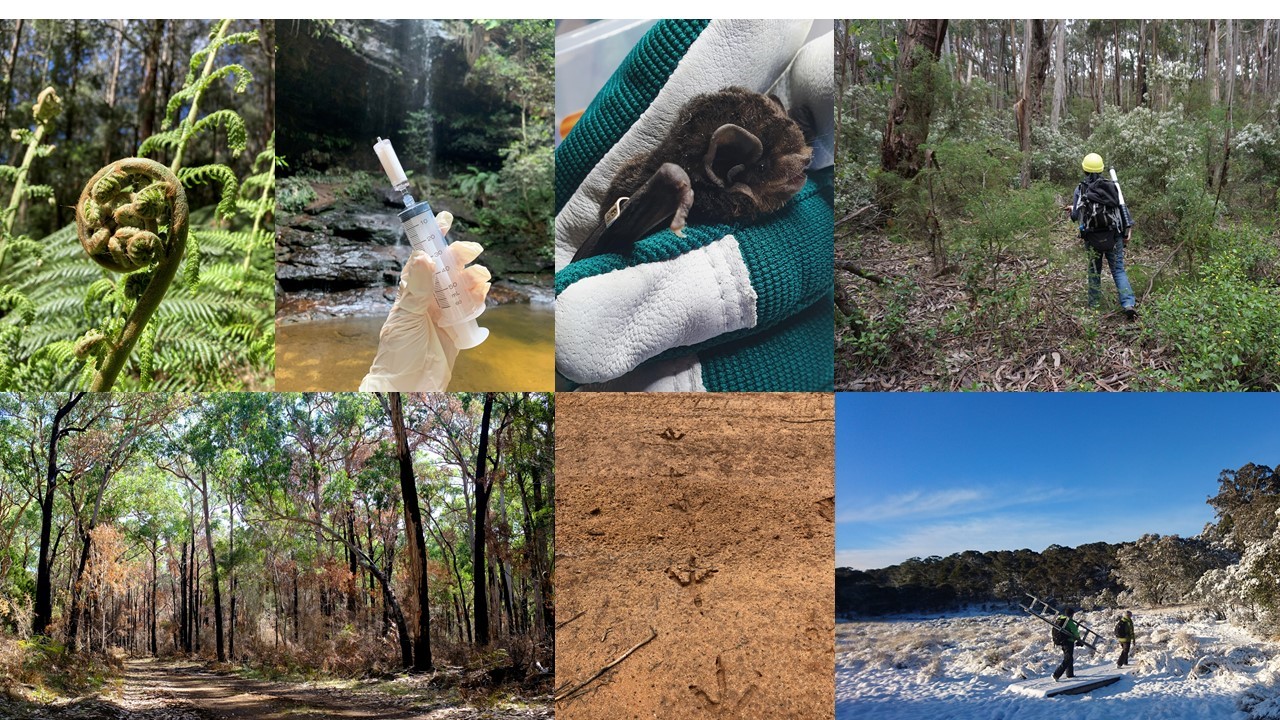
It’s make or break time for Australia’s national parks

This post was originally published on The Conversation and is authored by Euan Ritchie, William Laurance, Corey Bradshaw (re-blogged on his site), David Watson, Emma Johnston, Hugh Possingham, Ian Lunt and QAECO’s Mick McCarthy (re-blogged on his site too). It arose from a conversation that Euan Ritchie initiated on the social networking site Twitter.

National parks on land and in the ocean are dying a death of a thousand cuts, in the form of bullets, hooks, hotels, logging concessions and grazing licences. It’s been an extraordinary last few months, with various governments in eastern states proposing new uses for these critically important areas.

 Royal National Park

Royal National Park

Australia’s first “National Park”, established in 1879, was akin to a glorified country club. Now called the “Royal National Park” on the outskirts of Sydney, it was created as a recreational escape for Sydney-siders, with ornamental plantations, a zoo, race courses, artillery ranges, livestock paddocks, deer farms, logging leases and mines.

Australians since realised that national parks should focus on protecting the species and natural landscapes they contain. However, we are now in danger of regressing to the misguided ideals of the 19th Century.

Continue reading

Posted in Conservation, Qaecologists | Tagged , , , , , , , , , , , , , , | Leave a comment

Land abandonment and the decline of the Yellow-bellied toad in Liguria, northern Italy

By Stefano Canessa (This article was first published on the Europe Section of the Society for Conservation Biology Blog)

Across Europe, centuries of interactions between low-intensity human activities, such as extensive small-scale farming, and the surrounding environment have created what we now call “cultural landscapes”, which provide important ecosystem services and often support a rich biodiversity. However, since the second half of the 20th century several countries have witnessed large-scale social changes that have led to modifications in these landscape dynamics. There is growing evidence that this can also entail an impact to biodiversity, as the intermediate disturbance that can benefit species is lost or replaced by more disruptive activities (such as intensive vs. extensive farming: MacDonald 2000).

These same dynamics may be a leading factor in the disappearance of the yellow-bellied toad Bombina pachypus from peninsular Italy (Figure 1). The species has declined in the last thirty years and is now listed as Endangered by the IUCN. However, the causes of this decline are still unclear: in Liguria, northern Italy, habitat loss is believed to be the main driver, with recent systematic monitoring for the amphibian fungal disease chytridiomycosis failing to detect signs of this devastating pathogen (Canessa et al, in press).

The Apennine Yellow-bellied toad Bombina pachypus (photo: A. Arillo)

Figure 1. The Apennine Yellow-bellied toad Bombina pachypus (photo: A. Arillo)

In a recent study, we monitored sites across the region that were known to host the species until 2005: these were a combination of artificial sites (stone washtubs) and natural sites (small mountain creeks). We found that only five years later, in 2010, more than 50% of the populations had disappeared. When we searched for common traits among the sites where local extinctions had occurred, we found they had high densities of predators (dragonflies and newts), low insulation and dense vegetation. These in turn were linked to disturbance, with more frequent flooding and desiccation cycles beneficial in removing vegetation and predators and favouring tadpole survival.

In natural sites, flooding and desiccation are natural processes, and where they continue the species still occurs in relatively large numbers. On the other hand, in artificial sites disturbance is provided by traditional management (cleaning and dredging) (Figure 2): after land parcels or traditional practices are abandoned, sites degrade rapidly and become unsuitable. Significantly, in our study all artificial sites that had been abandoned by farmers immediately prior to or after 2005 did not host toad populations when we re-sampled them. Artificial sites that were still maintained (and therefore disturbed) were still occupied by the species.

Figure 2. The transition between a maintained artificial water body (left) and an abandoned one unsuitable for yellow-bellied toads (right) can occur within a few years (photos: S. Canessa)

Figure 2. The transition between a maintained artificial water body (left) and an abandoned one unsuitable for yellow-bellied toads (right) can occur within a few years (photos: S. Canessa)

This preference for disturbed sites matches observations for other yellow-bellied toads in Europe (Warren and Büttner, 2008), provides significant information for local conservation actions, and suggests the need to link ecological and socio-economic objectives: for example, in Liguria current efforts for the conservation of the yellow-bellied toad focus on the integration of traditional practices and biodiversity conservation in new forms of human activities, such as sustainable farming or eco-tourism. On the basis of this study, the Regional Park of Monte Marcello–Magra is coordinating a project, funded by the regional administration of Liguria, which includes the recovery of several semi-natural sites and the creation of new artificial sites that can be used by local farmers whilst providing suitable habitat for the species.

The conservation of culture and biodiversity needs is deeply connected in many parts of Europe: this requires an approach that is somewhat contradictive of the usual point of view of human activities as inherently negative. However, where large scale processes such as land abandonment are involved, they may be difficult to reverse by conservation funding alone. However, where traditional practices are still widespread, it is imperative that social and environmental planning should take into account the impacts on biodiversity that the abandonment of such practices may entail.

References

Canessa, S., Oneto, F., Ottonello, D., Arillo, A. and Salvidio, S. (2013) Land abandonment may reduce disturbance and affect the breeding sites of an endangered amphibian in northern Italy. Oryx, 47: 280-287

Canessa, S., Martel, A. and Pasmans, F. (in press) No detection of chytrid in first systematic screening of Bombina variegata pachypus (Anura: Bombinatoridae) in Liguria, northern Italy. Acta Herpetologica.

MacDonald, D., Crabtree, J.R., Wiesinger, G., Dax, T., Stamou, N., Fleury, P., Gutierrez-Lazpita, J. and Gibon, A. (2000) Agricultural abandonment in mountain areas of Europe: environmental consequences and policy response. Journal of Environmental Management, 59: 47-69.

Warren, S.D. , Büttner, R. (2008) Relationship of endangered amphibians to landscape disturbance. The Journal of Wildlife Management 72: 738-744.

Posted in ARC-CEED, Conservation, Papers | Tagged , , | Leave a comment

Recent Qaecologist blog posts (May 2013, Weeks 1 & 2)

QAECO post-doc Cindy Hauser kicked off this months’ blogging with her review of what’s been a good read on the internet during April. Cindy also let us know about a recent meeting of the Malleefowl-minded held in Ouyen.

Recent QAECO PhD graduate Sacha Jellinek has hit the blogs of late with three posts updating us on his whereabouts, employment and two recent publications to come out of his work while stationed in the QAECO lab.

Mick McCarthy recently gave a talk to the Mathematical Association of Victoria. He’s put slides up from his talk over at his blog.

The latest instalments of Amy Whitehead‘s Wildlife Wednesday series include the Praying Mantis and the Black-fronted Tern. Amy has also lent a hand to those struggling to combine data frames with the statistical programming language R.

Emily Nicholson has two important papers to tell us about. The first tests the focal species approach to conservation decision making. While the second introduces the science behind the IUCN’s Red List of Ecosystems. Geoff Heard also has a new paper out on a Bayesian model of metapopulation viability, with application to an endangered amphibian.

And finally, Kylie Soanes has photographic evidence to show us it’s not just gliders using her rope bridges across the Hume Highway.

Posted in ARC-CEED, Conservation, News | Tagged , , , , , , | Leave a comment

What could be wrong with transparent conservation decision-making?

By Michael Bode (This article first appeared in the Spring 2013 newsletter of the Resource Modelling Association. The newsletter and society journal - Natural Resource Modelling - contain some great articles on modelling that contains both biological and economic processes).

There is a famous, possibly apocryphal story about the genesis of Operations Research in the Second World War. According to the story, mechanics repairing flak-damaged Lancaster bombers noticed that the damage tended to occur with unusual frequency in particular sections of the aircrafts’ undercarriage. Additional armor was going to be added to these sections of the aircraft, in the hope that more would survive the frequent daylight bombing raids that were being planned. However, Bomber Command was one of the first sections of the Allied military to apply scientific analysis to their tactical military decisions, and the analysts in their Operations Research branch (the famous BC-ORS) made the counter-intuitive recommendation that armour be added to the undamaged parts of the plane. Their insight was based on an understanding of survivorship bias: these planes had returned precisely because the damaged areas were unimportant.

Lancaster B I dropping 4 lb incendiaries followed by a 4,000 lb "cookie" and finishing up with 30 lb incendiaries

Lancaster B I dropping 4 lb incendiaries followed by a 4,000 lb “cookie” and finishing up with 30 lb incendiaries

Continue reading

Posted in Conservation, News, post-docs | Tagged , , , , , , , , , , , , , , , , , , , , | 3 Comments

Species on the move: things to consider when translocating species

Anchor Island is one of the few predator-free islands off the New Zealand coast were Kakapo are still surviving following translocation (photo by Paul Nevin, http://bit.ly/13vbRaq)

Anchor Island is one of the few predator-free islands off the New Zealand coast were Kakapo are still surviving following translocation (photo by Paul Nevin, http://bit.ly/13vbRaq)

The last QAECO reading group tackled a topic of great interest to all the people in the group, be they Q, A, or ECO. We discussed a new paper in Annals of The New York Academy of Sciences where Mark Schwartz and Tara Martin review the potential use of translocations and managed relocations in the face of climate change, and then explore how these conservation actions lend themselves to a structured decision making approach.

As acknowledged by the authors, the paper was written at the same time as the IUCN guidelines and to a large extent it reflects their content, but the connection with decision theory was what really got us excited. Almost immediately, the most “A” of QAECOlogists (for “applied”) began to think – how can we really start implementing this? What are the key issues that we still need to resolve?

Continue reading

Posted in Reading Group | Tagged , , , , , , , , , , , , , , , , | Leave a comment

Recent Qaecologist blog posts (April 2013)

April marked the end of visiting PhD student Lucie Bland’s recent stint with the QAECO lab. Since then, she’s sure been busy, but that didn’t stop her from blogging. This month Lucie offers us a critical reading list for machine learning.

QAECO PhD student Hannah Pearson is celebrating completing her Masters degree late last year. And she’s celebrating in style. By blogging! Hannah’s posts this month introduced us to the wonderful world of Bayesian Networks and asked the question: what is a woodland bird?

Over at Amy Whitehead’s blog, the midweek multimedia menagerie continues unabated. This month, meet the western spotted frog, the marsupial residents of Barna Mia, the Adélie penguin and the short-beaked echidna.

QAECO post-doc Cindy Hauser reports from a workshop held in Brisbane recently, where attendees were honing their skills as facilitators. Speaking of honed skills; head on over to Geoff Heard’s blog, where you’ll find he has generously shared code and data from his recent research projects.

From the sublime to sublimely defying the ridiculous: PhD candidate Kylie Soanes tackles gender bias in science head on. And finally QAECO PhD student Els Van Burm kicks off her blog in style, with a post about a recent trip to Christmas Island.

Posted in ARC-CEED, post-docs, Qaecologists | Tagged , , , , , , , | 1 Comment

Bridging the great divide: road crossings and their value for wildlife

By Kylie Soanes (This article was first published in the April 2013 issue of Decision Point, The Monthly Magazine of the Environmental Decisions Group)

People need roads – whether it’s to travel across the country or nick down to the local shops. Unfortunately, roads – especially big ones – come with a high cost for many species of wildlife. For many animals, roads are big, noisy, sometimes lethal barriers. They cut through patches of habitat and restrict movement, dispersal and gene flow. They essentially have all the impacts of habitat fragmentation with the added risk of being flattened by a freight truck.

Road ecology is the study of the environmental impacts of roads and the ways we can try to mitigate these impacts. I see it as a bit like playing the 1980’s arcade game ‘Frogger’. There are a limited number of lives – our wildlife population – and we need to move animals safely across the road to access habitat, food and mates on the other side. If too many are killed by traffic, or don’t cross the road at all, we lose too many lives and the population goes extinct. Game over.

One of the most common methods of mitigating these impacts is to build crossing structures. These might be bridges that go over roads, or tunnels that pass under them. The purpose of these structures is to help wildlife cross safely.

Box 1 Easy snacks for wise predators?

Gliders are prey for large nocturnal raptors like barking or powerful owls. One concern is that an owl could sit and wait near a crossing structure for their next easy meal to walk across – they’re supposed to be wise after all. It’s something we keep an eye out for, but so far we’ve had no evidence of owl predation near the structures. Unfortunately, these owls are usually also threatened species and in a lot of places there aren’t many left to cause too much damage. If it were to become an issue we could install predator shields and refuge sites on the structures to give gliders and possums extra protection. It only becomes a problem, however, when the number of gliders eaten by owls while crossing the structure is more than the number of gliders that would be killed by traffic if the structure wasn’t there.


Bridging the gap for arboreal mammals

Not all roads are impassable to all species; but the bigger the road, the harder it is to cross. The squirrel glider, for example, is a small threatened marsupial in south-east Australia that has no problem crossing small roads. It’s great at crossing gaps in tree cover and can easily glide 30 – 40 m between trees. Unfortunately, major roads like the Hume Freeway (linking Melbourne to Sydney) are 50 – 100 m wide, and this presents a major problem for glider populations.

“To justify the cost of these efforts we need to know that mitigation is producing results”

Road ecologists working on squirrel gliders have used radio-telemetry to track the nightly movements of almost 50 gliders and found that while squirrel gliders could easily cross the short gap over quiet, single lane roads (control sites), they didn’t cross the 50 m gap across the freeway (van der Ree et al. 2010). However, at some freeway sites, squirrel gliders used tall trees present in the centre median as a ‘stepping stone’ and crossed in a few short glides. The freeway also reduced population survival rates, with mark-recapture revealing the survival rate of squirrel gliders living near the freeway was 60% lower than populations living at control sites further away (McCall et al 2010). The most likely cause is roadkill, as animals attempting longer glides across the freeway stray into the path of traffic.

Squirrel Glider on a rope bridge over the Hume Freeway in north-east Victoria.

As a result of this research, crossing structures were installed in 2007 at five sites where the Hume Freeway was a barrier to glider movement. These structures included glider poles and canopy bridges. The poles are tall wooden stakes, resembling oversized telegraph poles, in the centre median. They act as surrogate trees to reduce the gap across the freeway. Canopy bridges are long rope ladders strung between trees on either side of the freeway. They provide a structure for the gliders (and other wildlife) to climb across. These structures aimed to help squirrel gliders to cross safely, providing connectivity, reducing roadkill and ultimately enabling viable roadside populations.

Connectivity restored?

What we needed to know next was how well these structures worked and the first thing we investigated was animal movement. We installed motion-triggered cameras on the canopy bridges and glider poles to see which species would go across and how often.

Things started slowly – we detected only five squirrel glider crossings during the first two years. However, thanks to those brave pioneers, gliders eventually adapted to the structures and over five years of monitoring we’ve detected more than 2000 crossings (Soanes et al 2013). Other regular visitors include common brushtail possums, common ringtail possums, brush-tailed phascogales and sugar gliders. Even a goanna has had a go.

We also repeated the previous radio-telemetry study, allowing us to compare glider movements before and after mitigation at control sites and impact sites. Canopy bridges, glider poles and vegetated medians increased the probability that squirrel gliders would cross the freeway, while unmitigated sites remained a barrier to movement (Soanes et al 2013). However, no mitigation effort increased the probability that a glider would cross to the same level as control sites, those narrow, quiet roads. So, while movement was re-established, it was not restored.

Box 2 How effective a solution?

Mitigating the impacts of roads on wildlife is a major problem all around the world. Scientists working on this issue have even carved out a new discipline – road ecology. Millions of dollars are being spent on crossing structures helping everything from turtles to elephants safely cross roads. Many road agencies now rely on crossing structures to mitigate the impacts of construction projects on threatened species and meet regulatory requirements.

However, for the most part, we simply don’t know how well these mitigation measures really work because monitoring programs evaluating population-level impacts are rarely conducted. Long-term studies using before-after-control-impact population monitoring are required to truly evaluate the impacts of mitigation on population persistence. (see Decision Point 64)

It’s important to comprehensively evaluate these projects to ensure that successful strategies are widely adopted and unsuccessful ones are not repeated. If we’re going to rely on these structures for conservation, we need to be very sure that they work.


What’s next?

We now know that squirrel gliders need vegetated medians, canopy bridges or glider poles to cross major roads. We also know that even with these measures in place, the impact of the freeway on movement is only partially mitigated. What we need to know next is: Is this reduced movement enough to maintain viable populations and gene flow? If so, is it more cost-effective to install canopy bridges, glider poles or simply leave tall trees in the centre median?

We’ll answer these questions using before-after-control-impact monitoring. We’ll investigate changes in population size, survival rates, breeding patterns and gene flow because it’s not enough to know that animals use crossing structures. To justify the cost of these efforts we need to know that mitigation is producing results significantly better than no mitigation. If none of the methods effectively reduce impacts of roads on glider populations, we’ll need to look into alternatives.

It’s unrealistic to expect we will stop using these major roads (or that the building of roads will not increase), but it’s unacceptable that our need for road transport comes at the expense of continued species extinction. Mitigating the impacts of major roads on squirrel gliders is but the first step in the much bigger process of creating wildlife-friendly landscapes.

References

McCall SC, MA McCarthy, R van der Ree, MJ Harper, S Cesarini & K Soanes (2010). Evidence that a highway reduces apparent survival rates of squirrel gliders. Ecology and Society 15.

Soanes K, M Carmody Lobo, PA Vesk, MA McCarthy, JL Moore & R van der Ree (2013). Movement re-established but not restored: Inferring the effectiveness of road-crossing mitigation for a gliding mammal by monitoring use. Biological Conservation 159, 434-441.

van der Ree R, S Cesarini, P Sunnucks, JL Moore, A Taylor (2010). Large gaps in canopy reduce road crossing by a gliding mammal. Ecology and Society 15.

Posted in Conservation, Decision Point | Tagged , , | Leave a comment